


A planar truss is one where all the members and nodes lie within a two dimensional plane, while a space truss has members and nodes extending into three dimensions. The top beams in a truss are top chords and are typically in compression, the bottom beams are called bottom chords and are in tension, the interior beams are termed as webs, and the areas inside the webs are called panels.
Friday, 1 April 2016
TRUSSES AND TYPES
A planar truss is one where all the members and nodes lie within a two dimensional plane, while a space truss has members and nodes extending into three dimensions. The top beams in a truss are top chords and are typically in compression, the bottom beams are called bottom chords and are in tension, the interior beams are termed as webs, and the areas inside the webs are called panels.

HOOVER DAM AND ITS SIGNIFICANCE
HOOVER DAM AND ITS SIGNIFICANCE

Hoover Dam, once in the past known as Boulder Dam, is a concrete arch-gravity dam in the Black Canyon of the Colorado River, on the border ends between the United States of Nevada and Arizona. construction span of hoover dam is 5 years ( 1931 - 1936) during the Great Depression of this dam was dedicated on September 30, 1935, by Franklin.D(president). Roosevelt. Its construction was the result of a massive effort including thousands of workers, and cost over one hundred lives. The dam was contentious named after President Herbert Hoover.
Since about 1900, the Black Canyon and besides Boulder Canyon had been carryout for their budding to support a dam that would control floods, providing irrigation water and for producing hydroelectric power. In 1928, Congress approved the project. The winning bid in building the dam was submitted by a consortium called Six Companies, Inc., which starts construction of the dam in early 1931. Such a huge concrete structure had not ever been built before, and some of the techniques were unproven. The sultry summer weather and lack of facilities near the site also presented some sort of difficulties. Nevertheless, Six Companies revolve over the dam to the federal government on March 1, 1936, more than 2 years ahead of schedule.
Hoover Dam impounds Lake Mead, the biggest reservoir in the United States by volume. The dam is located near Boulder City, Nevada, a municipality originally constructed on the basis workers on the construction project, about 30 mi (48 km) southeast of Las Vegas, Nevada. The dam's generators used in providing power for public and private utilities in Nevada, Arizona, and California. Hoover Dam is termed to be a on of the major tourist attraction; nearly a million of people tour the dam each year. The heavily travelled U.S. 93 ran along the dam's crest until October 2010.
Thursday, 31 March 2016
IABSE Outstanding Structure Award for the year 2006; The Millau Viaduct:
The Millau Viaduct:
The 2006 'IABSE' of Outstanding Structure Awarded have been conferred to 3 structures: Hamburg The Central Bus Station, Germany, The Rion Antirion Bridge; Greece, The Millau Viaduct, France. Professor Manfred A. Hirt, President of the "IABSE", conferred of the Award at the Opening of the 'IABSE' Symposium "Structures and Extreme Events" in Budapest, Hungary on September 13th 2006.

The Award recognises the most curious, innovative,original, creative or otherwise stimulating structures are completed within the last short years. this consists of a Plaque to be fixed to the arrengement,formation, structure,model,architech and Diplomas for the Structural Engineer, the Architect, the Contractor, and the Owner.
The Millau Viaduct received the Outstanding Structure Award for being ‘an elegant, slender bridge climbing above a broad plain connecting two plateaus which was constructed using an innovative and creativity launching procedure and process which advanced the state of practice in bridge construction' and implement.
Cable-stayed bridge is placed in the Tarn River Valley in Southern France and was started on at December 14th 2004. It is continuous along with its eight cable-stayed spans (typical span of 342 m). The ‘useful projects life’ is 120 years. The deck is a trapezoidal profiled of metal box girder with an upper orthotropic decking. The 87 meters high pylons are composed of 2 stiffened metal box girders. The 11 pairs of cables which are support each span are arranged in a one plane in a half-fan madel.
Piers P2 (height 245 meters) and P3 (height 223 meters) are the 2 biggest piers ever built in the world. From their base to 90-100 meters below the adorn, the dam rise as a single hollow of shaft, so they have divided into two separated parallel shafts not parpendicular, which are each pre-stressed vertically by eight cables.
December 5th 2007:
Plaque Unveiling Ceremony at the Millau Viaduct, France
It was as if the weather had known just how to the behave when it display the Millau Viaduct from the mist and presented it under a crispy blue sky on December 5, 2007 for the Outstanding Structure Award plaque open ceremony.
The Ceremony, prepared and practice with the greatest support of the contractor ‘Eiffage’, took place under the Viaduct close to the ‘Cazalous’ info centre, where the plaque was mounted on a full scale model of the largest pier base.
Tuesday, 29 March 2016
PEARL BRIDGE AND ITS SIGNIFICANCE
History:
Before, akashi Kaikyo Bridge was built, ferries carried passengers across the Akashi Strait in Japan. This dangerous waterway frequently experiences severe storms, and in 1955 two ferries sank in the strait during a storm, killing 168 people. ensuing shock and public outrage convincing the Japanese government developing plans for a suspension bridge to cross the strait. The original plan expelled for a mixed railway-road bridge, but construction on the bridge began in April 1988, the construction was extent to road only, with six lanes. Actual construction work did not took up til May 1988, and the bridge was opened for traffic on April 5, 1998.
Structure:
 The bridge has three spans with a central span of 1,991 m (6,532 ft; 1.237 mi), and the two other sections are each 960 m (3,150 ft; 0.60 mi). The bridge is 3,911 m (12,831 ft) long overall. The two towers were originally 1,990 m (6,530 ft; 1.24 mi) apart, but the Great Hanshin earthquake which prone on on January 17 1995, moved the towers so much (only the towers had been erected at the time) resulting increasing of span by 1 m (3.3 ft).
The bridge was designed with a two hinged stiffening girder system, with capability of allowing the structure to withstand winds of 286 kilometres per hour (178 mph), earthquakes measuring up to magnitude of 8.5, harsh sea currents. The bridge also contains tuned mass dampers that are designed to operate at the resonant frequency of bridge damping . The main supporting towers rise 282.8 m (928 ft) above sea level 112 centimetres (44 in) in diameter and contains 36,830 strands of wire.
The Akashi-Kaikyo bridge Consisting total of 1,737 illumination lights: 1,084 for the main cables, 116 for the main towers, 405 for the girders and 132 for the anchorages. On the main cables three high light discharged tubes are mounted in the colors red, green and blue. The RGB model,computer technology make for a variety of combinations. 28 patterns are used for occasions as national or regional holidays, memorial days or festivities.
Before, akashi Kaikyo Bridge was built, ferries carried passengers across the Akashi Strait in Japan. This dangerous waterway frequently experiences severe storms, and in 1955 two ferries sank in the strait during a storm, killing 168 people. ensuing shock and public outrage convincing the Japanese government developing plans for a suspension bridge to cross the strait. The original plan expelled for a mixed railway-road bridge, but construction on the bridge began in April 1988, the construction was extent to road only, with six lanes. Actual construction work did not took up til May 1988, and the bridge was opened for traffic on April 5, 1998.
Structure:
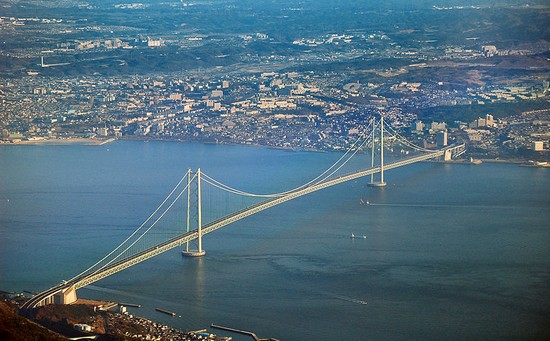
The bridge was designed with a two hinged stiffening girder system, with capability of allowing the structure to withstand winds of 286 kilometres per hour (178 mph), earthquakes measuring up to magnitude of 8.5, harsh sea currents. The bridge also contains tuned mass dampers that are designed to operate at the resonant frequency of bridge damping . The main supporting towers rise 282.8 m (928 ft) above sea level 112 centimetres (44 in) in diameter and contains 36,830 strands of wire.
The Akashi-Kaikyo bridge Consisting total of 1,737 illumination lights: 1,084 for the main cables, 116 for the main towers, 405 for the girders and 132 for the anchorages. On the main cables three high light discharged tubes are mounted in the colors red, green and blue. The RGB model,computer technology make for a variety of combinations. 28 patterns are used for occasions as national or regional holidays, memorial days or festivities.
Subscribe to:
Posts (Atom)


